
Austin Envisions a Transformed East Riverside Corridor with Affordable Housing
By Chad Swiatecki, Austin Free Press, October 13, 2026, 1:44 PM East Riverside Drive is poised for significant changes over the next decade if the $8.2 billion Project Connect light-rail transit line is realized.
By Chad Swiatecki, Austin Free Press, October 13, 2026, 1:44 PM
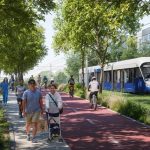
East Riverside Drive is poised for significant changes over the next decade if the $8.2 billion Project Connect light-rail transit line is realized. The city’s vision for the Grove-Riverside site encompasses light rail, bike lanes, sidewalks, more housing, retail options, and greenspace. A central concern for both residents and city officials is affordability for current inhabitants.
The corridor is planned to feature five light-rail stations, aimed at accommodating approximately 61,900 residents across over 32,000 residential units. Development regulations are under revision to permit taller structures and denser housing options around these future stations. The city is preparing 125 acres of its land for redevelopment near the rail line, with an emphasis on affordable housing that minimizes displacement of existing residents. Achieving this balance hinges on leveraging city-owned land and offering the right combination of subsidies and incentives to developers for deeply affordable housing.
Datasets from the U.S. Census Bureau indicate that nearly 90% of East Riverside residents are renters, and over 75% are people of color, with the median family income in the area ranking as the second-lowest in Austin. Displacement is reportedly already occurring.
Malcolm Yeatts, chair of the East Riverside/Oltorf Combined Neighborhood Planning Area Contact Team, expressed skepticism among residents about their influence in revisions to the plan, noting, “The people that worked on the original one are rather skeptical that their input is going to be even considered.”
While residents interviewed at a city feedback event generally supported transit enhancements and housing expansions, some voiced serious concerns over affordability, displacement, and pedestrian accessibility. Tim Thomas, a longstanding homeowner, advocated for density and reduced car dependence, yet feared rising expenses could jeopardize local businesses, stating, “If you don’t have cheap commercial spaces, you don’t get small businesses.”
Griselda Rodriguez, a 56-year resident, emphasized the necessity of addressing infrastructure issues like missing sidewalks and poor lighting to ensure safe access to the new rail system, adding, “It’s sad that we’re here now addressing affordability when it really has been a topic for the past 30 or 40 years.”
The timing is crucial, as Austin faces the opportunity to define the housing mix before both public and private developments reshape the area. An option at their disposal is the East Riverside Corridor density bonus program, which permits developers to construct taller buildings in exchange for providing affordable housing. However, more than ten years since its inception, city officials lament that few developers engage with the program due to the market and its initial design. Anna Villarreal, a principal planner, stated, “How it currently stands, it’s not being used.”
District 3 Council Member José Velásquez, covering part of the East Riverside corridor, noted that the East Riverside Regulating Plan rewrite is set for public review in the spring, which will encompass revisions for height allowances, development rights, and affordability requirements.
The city identified 15 developments under the density bonus program, comprising 3,644 housing units with an estimated 592 designated as affordable (16%). Among these, seven projects have been completed, two are in progress, and six are approved for future development. City officials did not clarify how many eligible projects advanced without utilizing the density bonus.
Currently, income-restricted rental units are generally available for households earning no more than 60% of the area median family income, remaining affordable for 40 years. Velásquez stressed the urgency of catering to households earning less than 50% of the median income. Future adjustments to the density bonus program aim to incentivize development at this lower threshold, but he cautioned against relying solely on development incentives, asserting public subsidies are necessary for true affordability.
The initial phase of Austin’s light-rail system, spanning 9.8 miles, is scheduled to commence in 2027 and conclude in 2033. The project has successfully navigated federal environmental reviews, yet funding from federal sources remains pending.
A focal point for housing plans lies around the prospective Grove-Riverside rail station, situated within three city-owned parcels totaling nearly 125 acres. The city intends to partner for the development of a diverse array of housing types, parks, and commercial and community facilities near the intersection of East Riverside Drive and Grove Boulevard. Most of this land was acquired for $87 million in 2024, utilizing about $27 million in anti-displacement funds alongside $60 million in property-tax-backed bonds.
The funds designated for anti-displacement target affordable rental housing for families earning below 50% of the city’s median family income. Specific requirements regarding the number of affordable units, income thresholds, and duration have not yet been established for the Grove-Riverside area.
Yeatts stated that his team is advocating for more affordable owner-occupied housing, as well as parks and community centers, echoing developments like the Mueller project. “They need more stable ownership so that this area maybe gets a little bit of political power,” Yeatts remarked.



Comments
No comments yet.