
Parents of Burnet and Webb Middle Schools Claim Austin ISD Has Let Them Down
Ingrid Saucedo expresses that parents at Burnet Middle School have been alerting Austin ISD officials for years regarding the challenges related to language barriers and frequent teacher changes affecting their children.
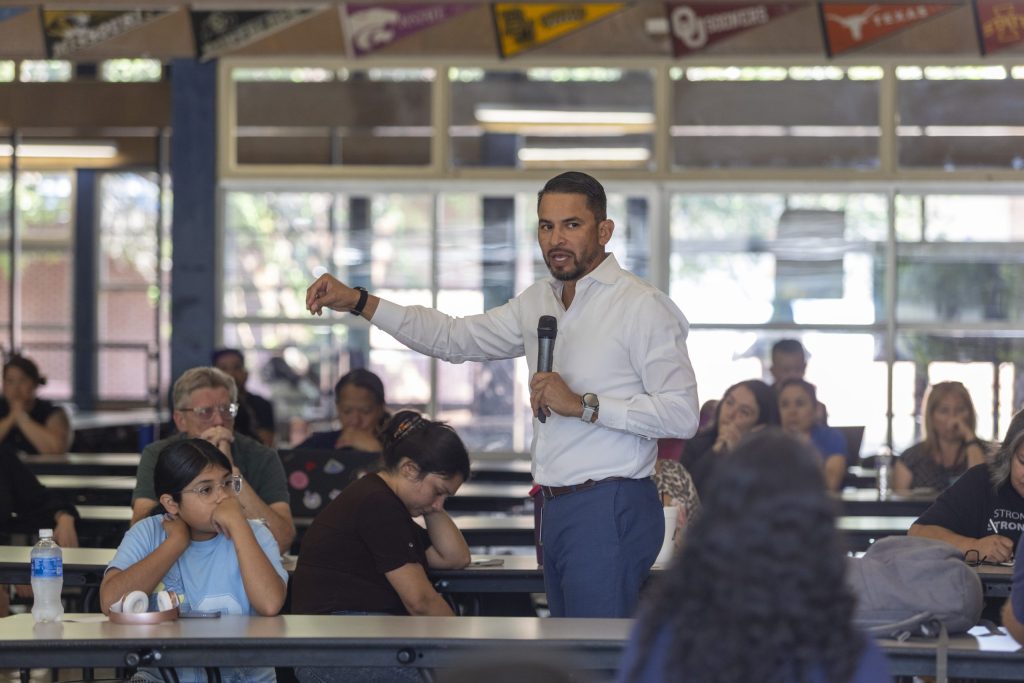
Ingrid Saucedo expresses that parents at Burnet Middle School have been alerting Austin ISD officials for years regarding the challenges related to language barriers and frequent teacher changes affecting their children. Now, they find themselves being asked to advocate for the closure of their own school.
Parents from Burnet and Webb middle schools have until October 15 to file petitions with Texas Education Commissioner Mike Morath requesting the closure of their campuses, a choice that city and district officials believe offers the best possibility for the communities to impact potential state intervention due to repeated failures to meet academic standards. Some parents, however, are questioning why they must take this step after enduring years of inadequate support, instability, and fluctuating staffing at their schools.
The option to petition is part of an obscure and less frequently used state law provision allowing parents at concerning campuses to participate in decisions surrounding state interventions. If Commissioner Morath agrees to the closure, Austin ISD leaders say that families could have a voice in shaping what comes next for the schools. However, education experts caution that even if closures occur, the district might still face additional sanctions.
Families are facing a daunting dilemma: whether seeking closure would provide them with true influence over their children’s prospects or whether it merely raises questions about the lack of proactive measures taken before these schools received five failing accountability ratings. Superintendent Matias Segura has admitted the district could have acted sooner.
Ongoing instability concerns exist among families at Burnet, Webb, and Dobie Middle Schools, which serve populations with significant needs. Data from the Texas Education Agency reveal that these are the only Austin ISD middle schools with over 90% of students being economically disadvantaged and more than 70% classified as English learners. Experts indicate that the requirement to administer state standardized tests only in English starting in middle school adds another layer of challenge for these schools.
Saucedo, a parent of students in seventh and eighth grades at Burnet, stated that parents had continually questioned the district leadership concerning the reliance on substitute teachers and the absence of qualified instructors in some classrooms. They sought English-language tutoring and advanced classes, which were briefly offered but later discontinued, leaving parents feeling unheard.
“Perhaps other schools experience different support because the district assists them, but in my own experience, we haven’t received adequate help or backing,” Saucedo conveyed in Spanish. “Thus, for us, the situation would remain unchanged whether we are part of an independent district or not.”
Saucedo also mentioned that Burnet Middle School underwent a principal change at the beginning of the last academic year, which led to a shift in plans for the school. Despite assurances from school and district officials about changes mandated by a state-imposed improvement plan following its fourth consecutive failing rating, her children’s schedules remained unstable for months.
During a recent discussion at the Texas Tribune Festival with Austin Current, Segura acknowledged a broader, persistent issue: Austin ISD had exhibited inconsistent expectations across schools in different areas of the city.
“Reflecting on the last several years, the standards and expectations established for schools with high percentages of economically disadvantaged students are areas where we have notably fallen short,” Segura admitted.
Burnet and Webb first received failing ratings in the 2018-19 school year under the state’s A-F accountability system. Over the past 15 years, Burnet experienced varying success in meeting state criteria, while Webb consistently performed well until that year.
Austin ISD implemented improvement plans for both schools in the 2022-23 school year amid a period of leadership turnover. Segura was appointed interim superintendent in December 2022 and formally took the position in January 2024, becoming the district’s third leader within less than a year.
Segura previously told parents during a meeting on September 28 that internal data prompted him to recommend changes as early as the 2022-23 school year. However, he faced opposition as the schools’ ratings were not made public due to ongoing litigation concerning the new accountability system. Parents resisted proposals to hand over the schools to an external operator in spring 2025, subsequently agreeing to a multiyear improvement plan instead.
He remarked, “This unique situation the schools find themselves in is a result of how everything unfolded. At the end of the day, we take responsibility for it.”
Months later, Austin ISD initiated a relaunch of Burnet under new leadership and staff following state directives. Segura described the delay in pursuing substantial interventions as one of his significant missteps while in office.
In a statement to Austin Current, the district noted that their improvement initiatives were in effect until the 2023 and 2024 accountability ratings were released in May 2025. Those ratings revealed a sharp decline, with the campuses moving from one unacceptable rating to four in a few months.
The district acknowledged the complexity of implementing a turnaround plan within a single school year. They explained, “The process necessary to establish a turnaround plan typically requires a full academic year, but Austin ISD had only three months to execute hiring, establish leadership, and create schedules. Initiating the hiring process over the summer complicates things considerably, and such efforts should have commenced by February or March at the latest.”
Austin ISD stated they provided additional support after the first unacceptable rating through salary incentives for teachers, increased tutoring opportunities, additional instructional guidance, and raised funding for programs and family engagement. Segura reportedly held several discussions about the schools’ requirements with their leadership, and conversations continue between the school improvement office and the superintendent.
The schools have recently started showing signs of improvement, with Burnet recording a five-point increase in its accountability score for the 2025-26 school year, yet still falling short by one point of achieving a passing grade, while Webb missed the mark by two points. Austin ISD has since filed an appeal for these ratings, but without changes, state intervention will be necessitated. Georgina Lopez, a parent of two students at Burnet, reported observing some advancements during the previous school year. While administrators highlighted improved test scores, she felt the district’s presumption regarding the school’s impending failure before the rating was made public adversely impacted the community. “They categorically labeled us as an F from the outset,” Lopez articulated in Spanish.
For a petition to move forward, over 50% of parents from each school must sign by October 15. Nevertheless, even if the threshold is achieved, the future of what might replace the schools is not guaranteed.
Segura informed parents that the petition represents the only legal avenue for families and the district to have an official role in deciding students’ placements. However, Morath would still possess significant authority over the outcome. Possible scenarios include school closures with students reassigned to neighboring institutions, or the reopening of schools with new leadership, staff, or external supervision. Additionally, the district might propose merging the two communities into a renovated Burnet campus under the 2022 bond program.
Following the latest meeting, Lopez expressed frustration that none of the available outcomes felt fair to students. “There is no hope, only confusion,” she concluded.



Comments
No comments yet.