
Prepare Students for Political Changes
Aditi Govil For UT students, a new law or federal policy changes more than the political discourse on campus; it changes how they pay for school, what they can study and even whether they can remain in the country.
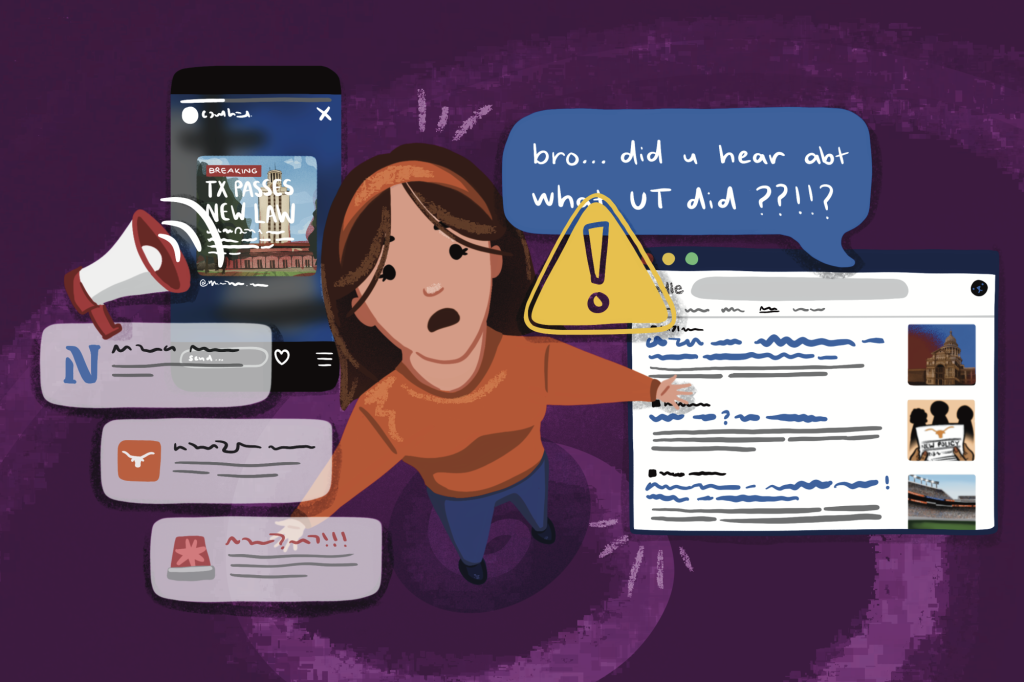

For UT students, a new law or federal policy changes more than the political discourse on campus; it changes how they pay for school, what they can study and even whether they can remain in the country. Unfortunately, many students are often left to figure out what these changes actually mean as the policies take effect.
In recent years, UT students have navigated changes involving immigration, diversity, equity and inclusion, financial aid and higher education. While students may first hear about these developments through social media or the news, understanding how a headline translates into their own education is much more complicated.
Luis Guevara, UT Department of Social and Cultural Analysis graduate program administrator, has been part of the University for over three decades. New state and federal policy changes have required faculty and staff to continually adapt procedures and help students understand new requirements. Recently, the federal government has imposed limits for opportunities for international students and those who do not hold citizenship status.
Advertisement
“I think that has been the most frustrating, (the changes) for us who work with students, whether graduate or undergraduate, are the changes in Visa policies, status, documentation, from Homeland Security and its various agencies,” Guevara said. “A lot of the changes, in terms of documentation and process, are going to put real strain on students … who want to come stay in the United States.”
That process becomes especially difficult when information must travel through several levels before reaching students. Guevara described information moving from government agencies to University administration, through colleges and departments and eventually to the faculty and staff directly interacting with students.
The problem is not necessarily that UT fails to communicate. The University and its offices, such as Texas Global, have worked to distribute information regarding changes affecting international students. However, even when information is shared this way, the implications and implementation mechanisms are not always clear, as the University itself may still be waiting for answers.
This uncertainty is also apparent from the student perspective.
“I went to (a statistics and data science) info session and learned (about the COLA major consolidations) from there,” government sophomore Srinija Gundlapally said. “I feel that’s the case for many students. They’re not aware of all of this stuff happening until someone actually tells them.”
Gundlapally said the experience left her unsure about what exactly was changing and concerned that other students might similarly be unaware of changes affecting their academic programs.
“I’m a little disappointed,” Gundlapally said. “I expected better, especially from this huge of a university, because UT is amazing for many things — its education, sports and stuff like that. When it comes to hearing and noticing, they’re not the best (at) communicating.”
Students may also struggle to determine where to go for reliable information or whom to contact with questions, describing the process as “searching in the dark.”
The University cannot control what lawmakers in Austin or Washington, D.C., decide, but they can control how they communicate those decisions.
UT should create a centralized, politically neutral resource for major state and federal policy changes affecting students. Rather than advocating for or against policies, the resource could answer: What changed? Who is affected? Where can students go for help? When a change has particularly broad consequences, the University should also send intentional University-wide announcements directing students to that information, as opposed to occasional emails from the president’s office.
Students should still read University emails and seek out information relevant to them, but understanding whether a new law threatens their financial aid, immigration status or academic plans should not depend on how well they can navigate a maze of government announcements and University offices.
Puente is a psychology and plan II major from Edinburg, Texas.
This story was originally published by The Daily Texan.


Discussion
Share your perspective. Please stay respectful and keep comments relevant to this story. Comments are reviewed before appearing.
Start the conversation — no comments here yet.
Discussion at the original source
These comments belong to readers of the original publisher. Replies here stay on this website.
Source comments are not available here. Visit the original article to check its discussion.
Open original article